
Cost & Measuring
How Much Wallpaper Do I Need? A Simple Measuring Guide
Calculating how much wallpaper you need is simpler than it seems. This guide walks you through the exact steps to measure any wall, ensuring you order the right amount without costly mistakes.

The short version
- Measure the total width and height of your wall at their widest and tallest points, ignoring any slopes, doors, or windows for this initial measurement.
- Add a bleed of about 4 inches (10 cm) to both the final width and height measurements to allow for trimming and ensure a perfect fit.
- For standard wallpaper rolls, you must calculate pattern repeat and the number of drops you can get from one roll, which often leads to significant waste.
- With a made to measure mural, you simply provide your final wall dimensions; the design is printed to fit, and it arrives in numbered panels ready to hang.
To find out how much wallpaper you need, measure the full width and height of your wall at its widest and tallest points. Always include doors and windows in this overall measurement. Finally, add about 4 inches (10 cm) to both the total width and height to account for trimming.
How do you measure for wallpaper? The basic steps
Getting your wall measurements right is the most important step in any wallpapering project. An accurate measurement ensures you order the correct amount, saving you from the frustration of running short or the cost of buying too much. Follow this simple process for a perfect measurement every time.
A made to measure wall mural is printed as a single image to your exact dimensions, so you only need one set of measurements. For traditional repeating pattern wallpaper, you will need to measure each wall you intend to cover.
-
Clear the Wall
Before you begin, remove any picture frames, shelves, or furniture that might obstruct your tape measure. You need a clear, flat run from one side of the wall to the other and from floor to ceiling.
-
Measure the Width
Using a metal tape measure, measure the horizontal width of the wall. To ensure accuracy, take this measurement at three different points: once near the top, once in the centre, and once near the bottom. Walls are rarely perfectly square, so these numbers might differ slightly. Record the widest of the three measurements.
-
Measure the Height
Next, measure the vertical height of the wall. Again, do this at three different points: once on the far left, once in the centre, and once on the far right. Just as with the width, walls can vary in height from one end to the other. Record the tallest of the three measurements.
-
Add the Bleed
Once you have your final, widest width and tallest height, add an extra 4 inches (10 cm) to each number. This additional margin, known as 'bleed', is crucial. It gives you room for error and allows you to trim the wallpaper perfectly to the edges of your wall, ceiling, and skirting boards for a professional finish.
How to measure a wall with doors and windows
A common question is whether to exclude doors, windows, or built-in cabinets from the measurements. The answer for achieving a professional finish, especially with a wall mural, is simple: you do not exclude them. You should always measure the wall as if these features are not there.
Measure the full rectangular area of the wall from the widest and tallest points. For example, if your wall is 140 inches (356 cm) wide and 95 inches (241 cm) tall with a window in the middle, your measurements are 140 inches by 95 inches. Do not subtract the window's area.
This method ensures that the pattern of your wallpaper or the single image of your mural remains continuous and correctly aligned across the entire wall. During installation, you will hang the wallpaper panels over the openings and then carefully trim away the excess from around the window or door frame. This creates a much cleaner and more integrated look than trying to piece smaller sections together.
Murals made to your measure
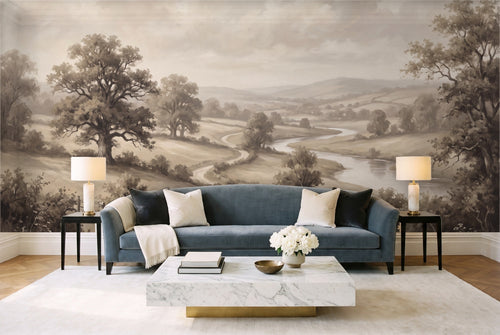
 Candlemas, MossPrinted to your wall size
 Southwark, StonePrinted to your wall size
 Alexandrine, OnyxPrinted to your wall size
What about sloped ceilings or awkward shapes?
Walls with sloped ceilings, such as those in loft conversions or under stairs, can seem tricky, but the principle remains the same. Your goal is to find the single largest rectangle that the entire wallpapered area will fit inside. Do not attempt to measure the diagonal slope itself.
Instead, measure the greatest overall width and the greatest overall height of the wall. This creates a rectangular boundary that encompasses the whole shape, including the sloped section. The wallpaper mural will be printed as a full rectangle, and you will simply trim away the excess material along the slope after hanging.
For example: On a gable wall, measure from the furthest left point to the furthest right point for your width. For the height, measure from the floor to the highest point of the ceiling's peak.
These two numbers are all you need. This approach guarantees that a grand design, such as a cityscape like Southwark, Stone, scales correctly and is not distorted, giving you a flawless finish even on the most unusual walls.
How many rolls of wallpaper do I need?
Calculating the amount of wallpaper you need differs significantly between traditional wallpaper rolls and made to measure murals. While both can transform a room, the ordering process is very different, with made to measure offering a far simpler solution that minimises waste.
Understanding the distinction is key to answering 'how do i measure for wallpaper' for your specific project. A made to measure mural is designed to fit your wall perfectly, whereas standard rolls require complex calculations to account for pattern matching and waste.
| Feature | Standard Wallpaper Rolls | Made to Measure Murals |
|---|---|---|
| Calculation | Complex. You must calculate wall area, pattern repeat, and the number of 'drops' per roll, often resulting in buying extra rolls. | Simple. You provide the final wall width and height (including bleed). The calculation is done for you. |
| Waste | High. Significant waste can be generated from cutting rolls to match the pattern repeat. | Minimal. The only waste is the small amount of bleed you trim from the edges after installation. |
| Design | Repeating Pattern. The design repeats vertically and sometimes horizontally across the wall. | Single Image. A large, non-repeating image, like a landscape or abstract art, covers the entire wall. |
| Installation | More difficult. Requires careful alignment of the pattern repeat for each drop, which can be time-consuming. | Straightforward. Panels are numbered and hung in sequence from left to right, with no pattern matching required. |
For a detailed breakdown of measurements and patterns, our full wallpaper calculator guide offers more examples. Ultimately, a made to measure product removes the guesswork and potential for costly errors.
See your design at the perfect size
All our murals are printed to your exact wall dimensions.
How much wallpaper do I need for a 12x12 room?
Let's use a common room size to illustrate the difference. A 12x12 room means each wall is 12 feet (or 144 inches / 366 cm) wide. We will assume a standard ceiling height of 8 feet (or 96 inches / 244 cm).
For a Single Feature Wall (12 ft x 8 ft)
With a Casavono Made to Measure Mural: The process is straightforward. You measure the wall, which is 144 inches wide by 96 inches high. Then you add the 4-inch bleed to each dimension.
- Final Width: 144 + 4 = 148 inches
- Final Height: 96 + 4 = 100 inches
You would enter 148 x 100 inches into the product page. That is all the calculating you need to do. Our free online wallpaper calculator can confirm this for you instantly.
For All Four Walls
With a Casavono Mural: You would measure each wall individually and order four separate murals. This allows for different designs or ensures features like doors and windows are accounted for on a per-wall basis, which is ideal for creating a continuous panoramic scene.
With Standard Wallpaper Rolls: The calculation is much more involved. You need the perimeter of the room (12 ft x 4 walls = 48 feet). You also need to know the roll's width, length, and pattern repeat.
You would calculate how many 'drops' (floor-to-ceiling strips) you can get from one roll, factoring in the waste from matching the pattern. This complexity often leads to buying at least one or two extra rolls 'just in case'.
What tools do I need to measure for wallpaper?
You do not need a lot of equipment to measure your walls, but using the right tools will ensure your figures are accurate. Precision at this stage is vital for a smooth project, preventing issues when it comes time to hang your wallpaper.
Here are the essential tools for measuring:
- Metal Tape Measure: A retractable metal tape measure is non-negotiable. Unlike a fabric or plastic one, it will not stretch or sag over long distances, giving you a true reading.
- Pencil and Notepad: Keep a dedicated notepad to write down your measurements as you take them. It is easy to forget the numbers, so record them immediately.
- Step Ladder: Unless you have very low ceilings, a sturdy step ladder is necessary to safely and accurately measure the full height of the wall at the top.
- Spirit Level (Optional): While not for measuring dimensions, a long spirit level or a laser level can help you check how square your walls and corners are, which is useful information to have before you start.
These tools are just for the measuring phase. For a full list of equipment needed for the next stage, see our complete wallpaper installation guide.
Double-Check Everything. Measure twice, order once. Before you finalise your order, take a moment to re-measure everything one last time. This simple check can save you from a costly mistake.
Common measuring mistakes to avoid
Even with the best intentions, small errors can happen during the measuring process. Being aware of these common pitfalls is the best way to avoid them and ensure your wallpaper project is a success from the very beginning.
Mistake 1: Forgetting the bleed. One of the most frequent errors is ordering wallpaper to the exact wall size. Walls are never perfectly straight. The extra 4 inches (10 cm) of bleed on the width and height gives you the margin needed to trim for a crisp, perfect edge.
Mistake 2: Using a fabric tape measure. Soft tape measures, like those used for sewing, can stretch over time or sag when held across a wide space. This can lead to inaccurate measurements. Always use a rigid metal tape measure for home improvement projects.
Mistake 3: Measuring only once. Do not rely on a single measurement for width or height. As walls are often uneven, measuring at three separate points and taking the largest value for each dimension is the only way to guarantee your wallpaper will cover the entire surface.
Mistake 4: Guessing or rounding. Do not round your measurements up or down to a 'neater' number. Precision is key. Record the exact figures you see on the tape measure to ensure the best possible fit for your mural or wallpaper.
Why choose made to measure wallpaper?
When planning your project, the choice between standard rolls and a made to measure product can have a big impact on the process and the final result. While both can beautify a space, a made to measure mural from Casavono offers distinct advantages that simplify the entire experience.
The primary benefit is the elimination of complex calculations. You do not need to worry about pattern repeats, roll widths, or how many drops you can get from a roll. You provide your wall dimensions, and the mural is printed to those exact specifications. This is particularly helpful for large-scale designs, like the subtle texture of Volterra, Oat, which looks best as one continuous piece.
This approach also drastically reduces waste. With standard rolls, the material lost to pattern matching can be substantial. A made to measure mural is printed specifically for your wall, meaning the only excess is the small bleed trimmed from the edges.
As you can learn in our guide on how it works, your mural arrives in panels that are numbered for simple, sequential installation, creating a single, stunning image like the dramatic Firmament, Onyx without any frustrating pattern alignment.
More murals to consider
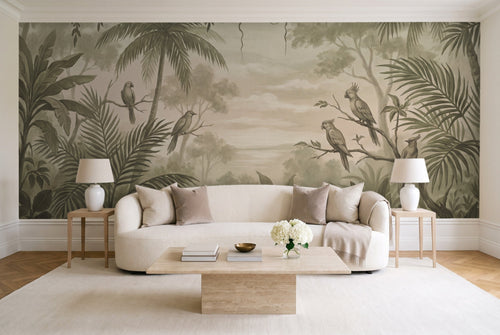
 Glenalmond, OchrePrinted to your wall size
 Volterra, OatPrinted to your wall size
 Firmament, OnyxPrinted to your wall size
Common questions
Do I need extra wallpaper for repairs?
For standard wallpaper rolls, it is wise to keep leftover paper for future repairs. Since a made to measure mural is printed to your wall's exact dimensions, there are no extra rolls to set aside for this purpose.
Should I measure around plug sockets and light switches?
No, do not subtract the area of sockets or switches from your main measurements. Measure the entire wall as a solid rectangle. During installation, you will hang the wallpaper over these fittings and then carefully cut around them with a utility knife for a clean, seamless finish.
Does wallpaper pattern repeat affect how much I need?
Yes, significantly for standard wallpaper rolls. The pattern repeat is the vertical distance before the pattern begins again. You must account for this on every strip you hang to ensure they align, which creates waste. For a made to measure mural, there is no pattern repeat calculation needed.
What is wallpaper 'bleed'?
Bleed is an extra margin of the printed design, typically a few inches or centimetres, added to the edges of your wallpaper. It is not part of the main design but ensures you have enough paper to cover your surface completely, even if your walls are not perfectly straight or square.
Can I use the same measurements for any type of wallpaper?
The wall measurements themselves will be the same, but how you use them differs. For a made to measure mural, you use the final width and height. For standard rolls, those same measurements are just the starting point for more complex calculations involving roll size and pattern repeat.
How do I prepare my wall after measuring?
Once measured, your wall must be smooth, clean, and dry. Any holes or cracks should be filled and sanded. If the wall is freshly painted, it needs three to four weeks to cure fully before wallpapering. Our guide on how to prepare a wall for wallpaper has the complete checklist.
Made to your measure
Murals for the wall you have in mind


Before you order